
In 2022, Indonesian Corruption Watch (ICW) reported 579 cases of corruption nationally, with 155 occurring at the village level. By 2023, the number of cases nationally had increased to 791, with 187 cases involving Village Heads (Kepala Desa) or the Village Apparatus (Perangkat Desa). Additionally, the Indonesian Central Bureau of Statistics (BPS) released its Anti-Corruption Behaviour Index (ACBI) in 2024, revealing that urban communities have a better score than their rural counterparts.
To prevent corruption and promote anti-corruption values at the village level, Indonesia’s Corruption Eradication Commission (KPK) launched an initiative called Desa Antikorupsi (Anti-Corruption Village) in 2021. The main components of this program include:
- Education and Awareness: Spreading the importance of integrity and anti-corruption values among village governments and communities;
- Improving Governance: Enhancing integrity of village governance by adhering to guidelines outlined in the Anti-Corruption Village Handbook;
- Community Participation: Encouraging active participation from all community members, including religious leaders, youth, and women, in preventing and combating corruption.
The program consists of various phases such as technical guidance, observation, and evaluation to ensure villages meet the criteria to become Anti-Corruption Villages.
During fieldwork in 2023 on the experiences of smallholder farmers in Central Java when dealing with climate change, however, I found that corruption cases still abound in villages in this part of Indonesia. As I explored the psychological stressors farmers face from climate change and the resources they use to cope with these stressors, almost all interviewees expressed distrust towards the state, with corruption mentioned not only as an irritation but as a hindrance to, for example, recovery from crop failure. Three corruption-related experiences were highlighted by interviewees:
Irregularities in Social Protection Assistance
One interviewee was frustrated that many in his neighbourhood received cash as social protection assistance, but that he had not. He checked this matter with the Social Department and found that his name was indeed on the list of supposed recipients. Yet, the Village Head and Village Apparatus denied knowing about this. The interviewee did not report this case. Instead, he accepted it, though it made him upset.
Uneven benefits in the Agriculture Insurance Programme
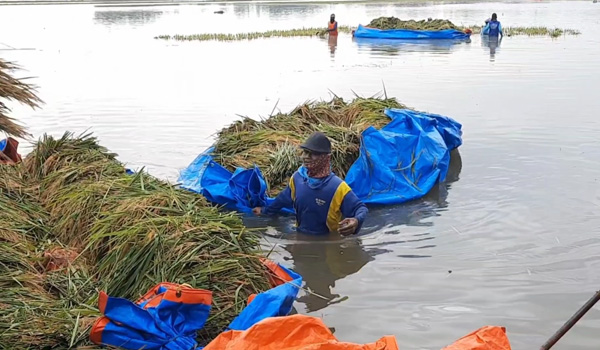
The government introduced an agriculture insurance program to help farmers cope with crop failures. However, many farmers rely on the Village Apparatus to sign up and file claims due to a lack of knowledge or reluctance to deal with administrative work. Following a flood, some participants received benefits, but suspicions arose regarding the varying amounts provided. One participant claimed village officers illegally took a portion of their benefit, highlighting a common practice that often goes unreported.
Illegal Levies to Attain Recommendation Letter to Buy Fuel
The government issued regulations in 2021 to reduce carbon emissions and optimize fuel distribution. If people wanted to buy subsidized fuel, they had to apply for a Letter of Recommendation to do so. This involved submitting many documents at the village and district levels. This bureaucracy frustrated farmers and was misused by some public officials who issued illegal levies.
My research shows that reducing village corruption would help farmers cope with at least some of the stressors they face from climate change in Central Java. Establishing public services at the village and district levels are important for climate change preparedness and amelioration in rural areas. But given the prevalence of village corruption in Indonesia, it is vital that these public services are accompanied by information campaigns that sensitize communities as to their entitlements.
Improving the role of Village Deliberation Agencies (BPD) is also crucial to tackle corruption at the village level. As outlined in Law no. 6/2014 on Villages, the BPD is responsible for representing the aspirations of village communities and overseeing the performance of the Village Head. However, my research shows that many BPD members do not fully understand their roles and exist as a rubber-stamp. There is a need to optimize the BPD’s role, particularly in terms of monitoring, evaluating, and reporting on the Village Head’s performance, but also in terms of supervising policy implementation.
Finally, eliminating money politics from village elections and the selection of village officials would be an important step forward. Money politics is not a new phenomenon, and candidates often compete by offering money, referred to as ‘pocket money’, as a form of compensation for voters’ support. Instead of focusing on their vision, mission, and workplan to improve the community, candidates are instead focused on buying votes. As a result, and as show in cases investigated by the KPK, elected candidates may then misuse village funds to repay the money spent during the election. (Meta Mulyani)
 Global Development